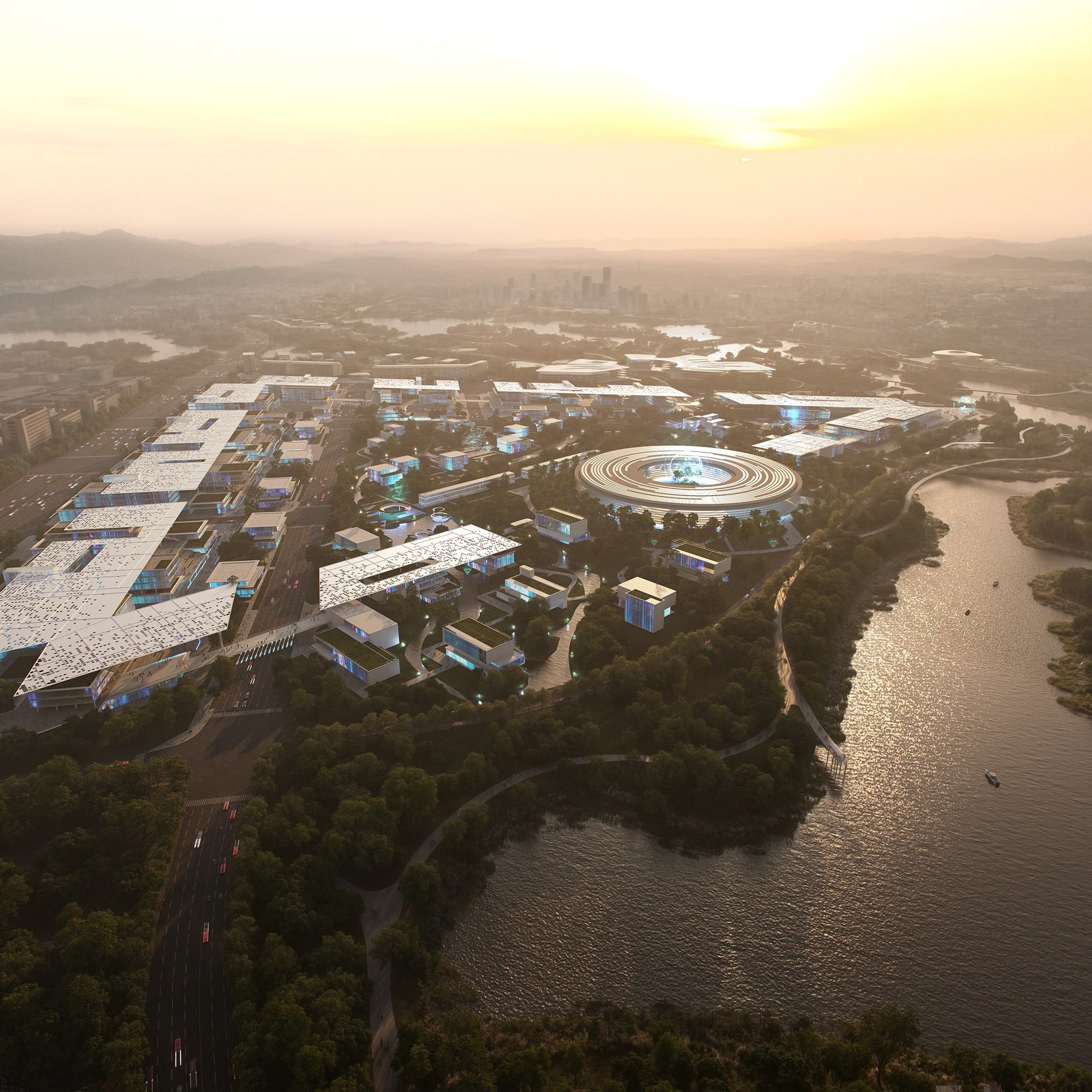
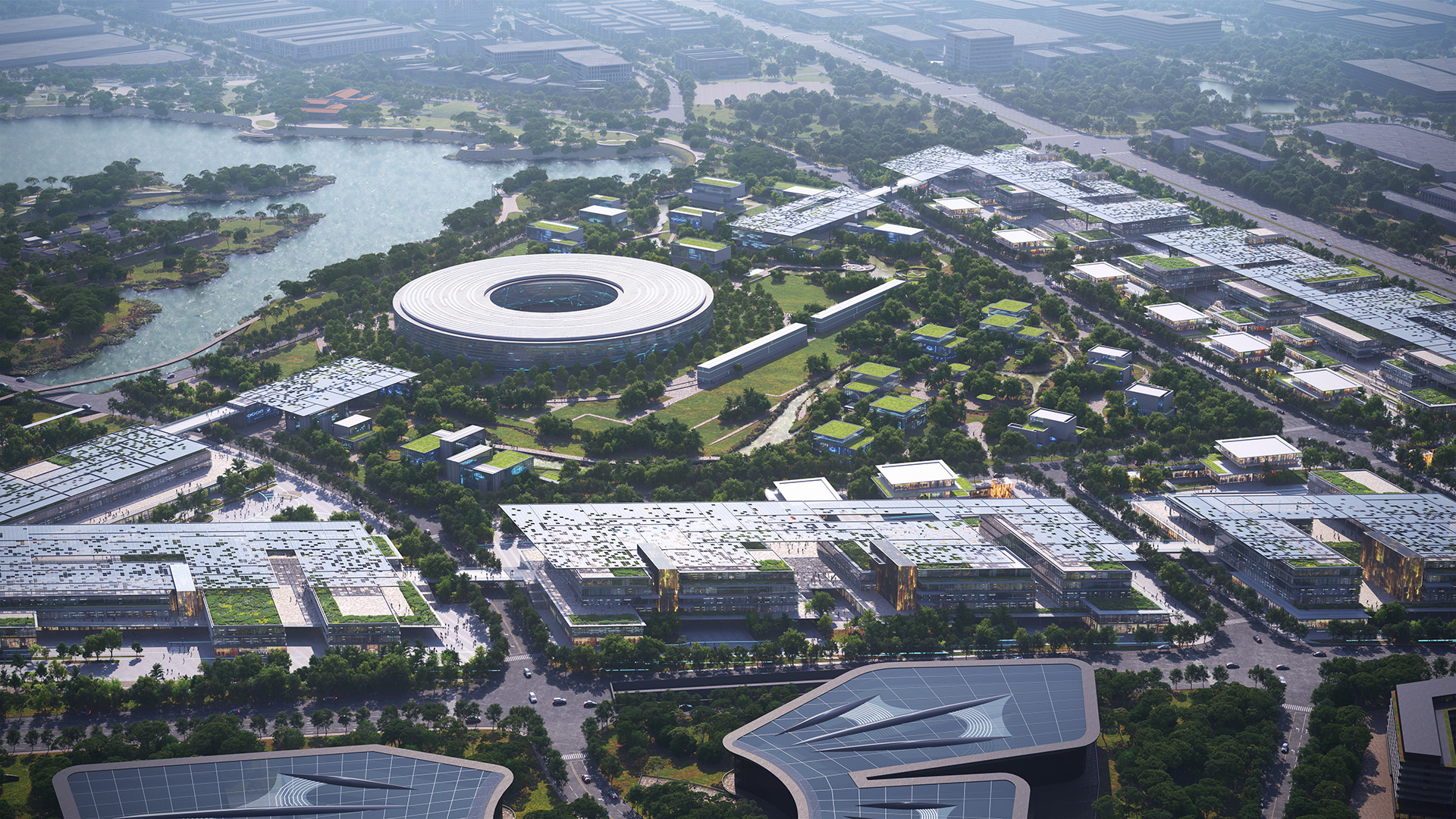
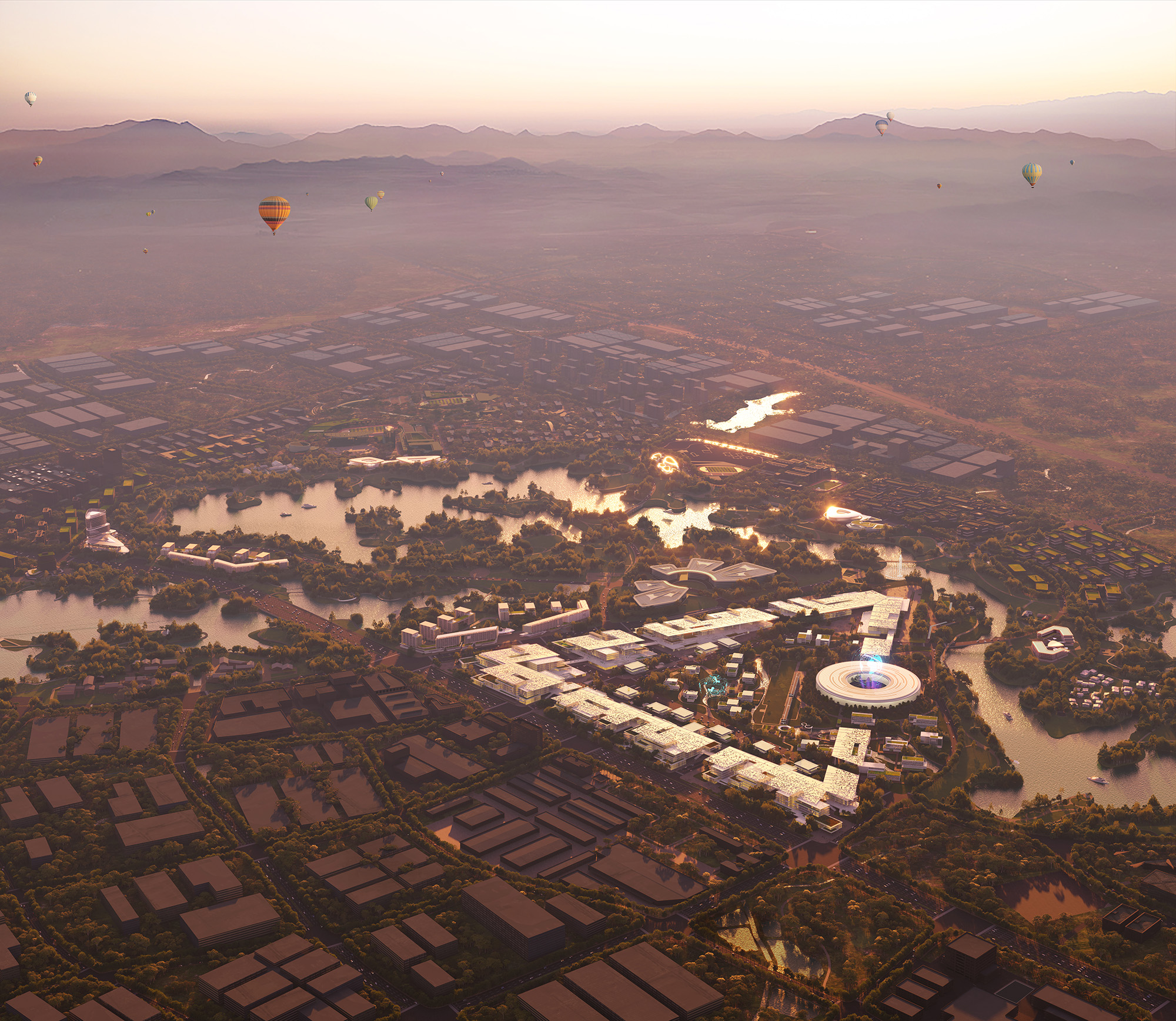
The masterplan rises naturally from the lakeshore, creating a series of tiered platforms and cascading gardens that blur the boundaries between architecture and landscape, city and nature. This strategy of ‘urban fabric camouflage’ allows the building clusters to appear as though they have grown from the land itself, rather than being imposed upon it. The massing ascends gently from the lake towards the urban scenario to the south, forming a natural crest parallel to the shoreline – mediating the urban scale while preserving an intimate connection with nature.
The essence of ‘landscraper’ lies in its unity: it weaves diverse programs – R&D, incubation, commerce, culture, and living – into a continuous fabric, cultivating a strong sense of place and community.
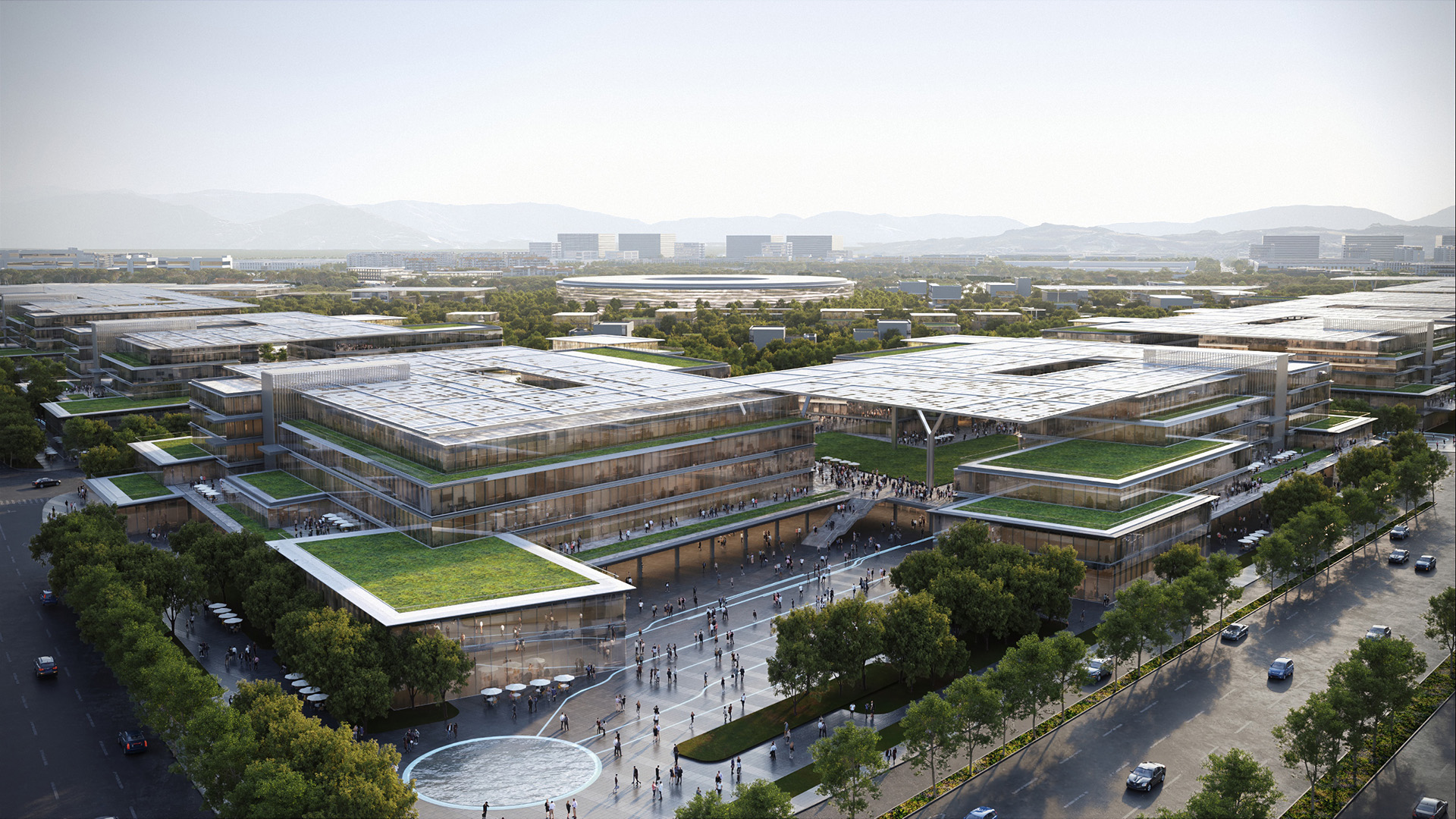
The architectural core is defined by a highly distinctive triangular horizontal landscraper, serving as the central engine for offices, commerce, and R&D. The interior design focuses on cultivating an industrial ecosystem, serving six frontier sectors: integrated photonics, modern Chinese medicine & biotechnology, new energy, new materials, information innovation, and innovation services. The spatial program carefully balances enterprise R&D, shared production support, and shared lifestyle amenities. The lower levels are dedicated to enterprise services and daily amenities, while the upper levels offer a variety of spaces, from flexible offices to pilot-production labs.
A core design philosophy is flexibility and adaptability. Through a modular, reconfigurable spatial system, the project provides immediately suitable environments for companies at every stage, from startup to maturity. The design also fully accommodates the need for rapid conversion between pilot-production and R&D spaces, allowing the architecture itself to evolve organically alongside the enterprises it houses.
Unlike conventional planning with vertical towers that block sunlight and airflow, this horizontally articulated form allows daylight to penetrate deep into every corner, promotes natural ventilation, and invites flora and fauna to permeate the urban tissue, forming a true ecological symbiosis.
Behind it, along the lakeshore, a constellation of seven elements – commercial complex, innovation community, cultural district, creative workshops, hotels, and apartments – is arranged in a ‘Stars Surrounding the Moon’ formation, creating a functionally mixed and dynamically interwoven innovation neighborhood.
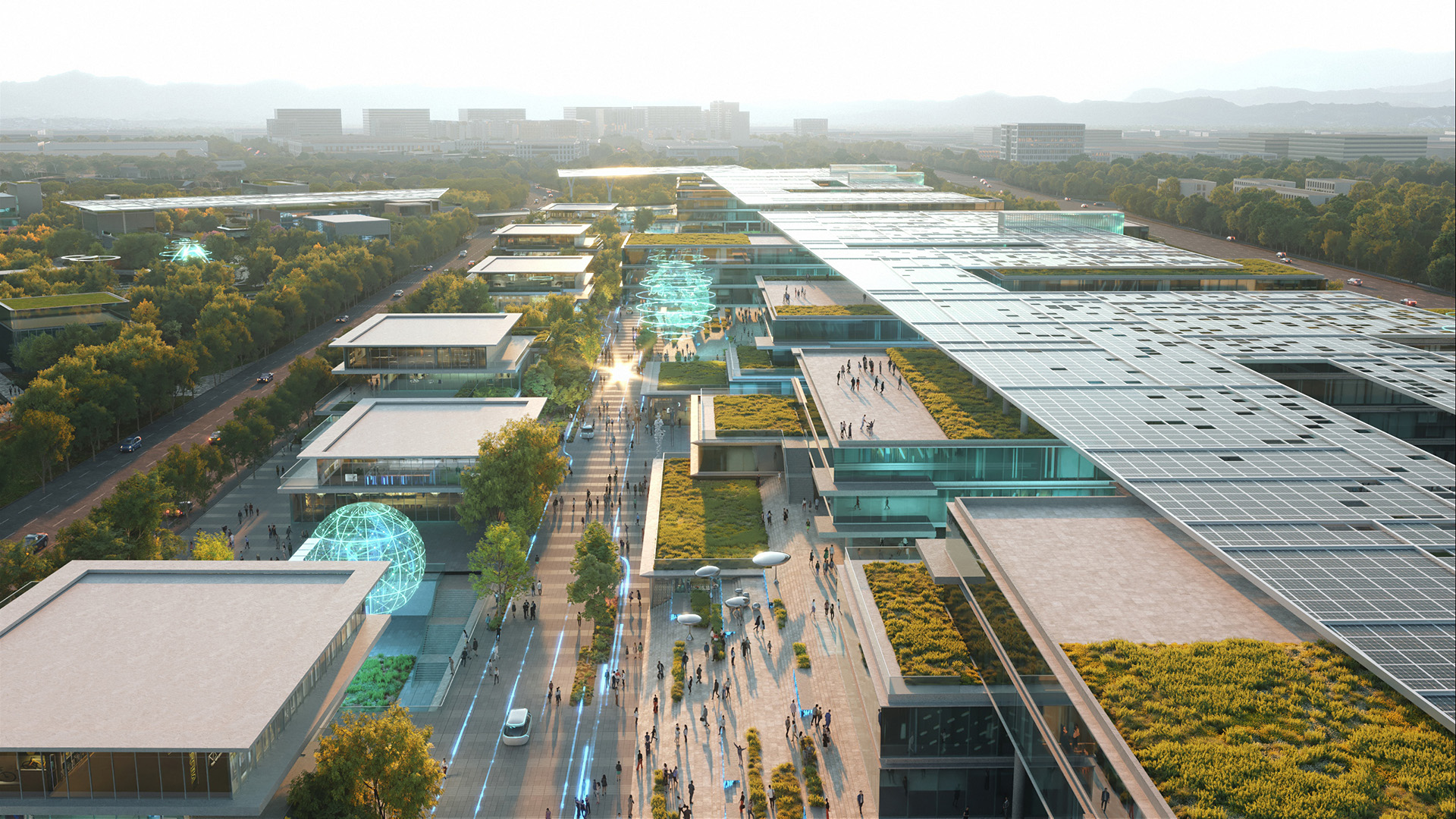
The work and living environment truly needed by today’s research talent is deeply considered – a young, dynamic, and often high-pressure community of thinkers. The answer lies in creating a series of spatial scenes that stimulate serendipitous encounters, deep focus, and mental restoration.
The project employs nine specialized technical systems to ensure high-quality delivery. Among these, the integrated roof system stands as a core signature where technology meets aesthetics. The large-scale solar photovoltaic panels covering the building clusters not only create a highly futuristic form but also combine multiple functions: shading, passive ventilation, concealment of MEP equipment, and nighttime illumination. After dark, these roofs transform into distinctive luminous landmarks, tracing the captivating skyline of the Jinyi Lake Source of Science and Technology Innovation.